EN
EN
 Chinese
 Turkish
 Indonesian
 German
 French
 Spanish
 Portuguese
 Russian
 Italian

How to Choose the Right Edible Oil Refinery Machine?
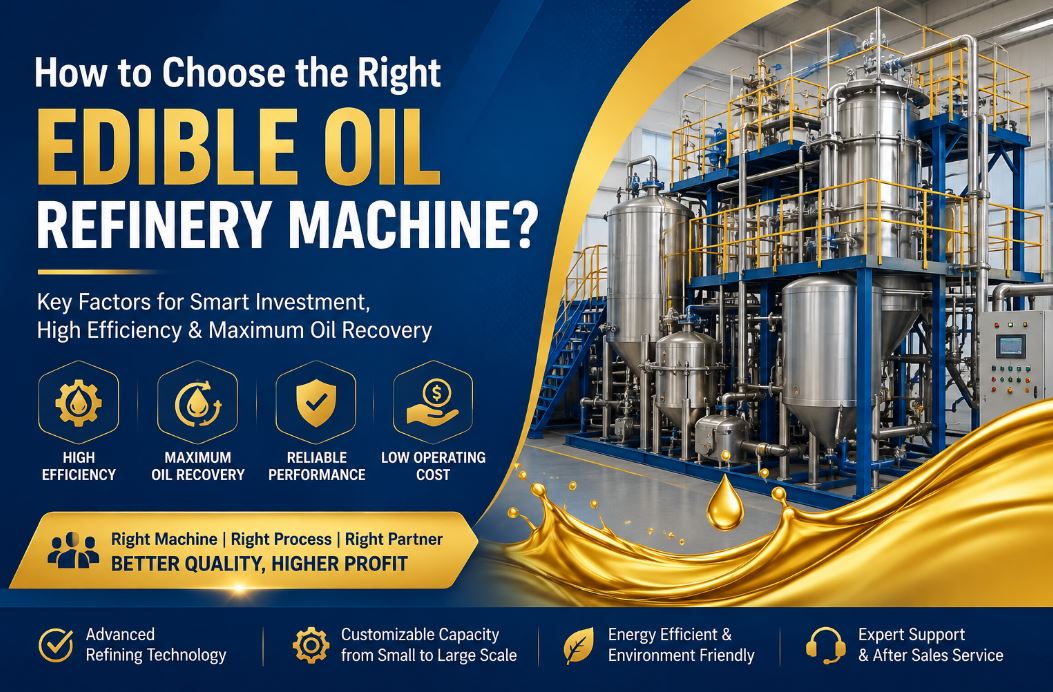
Choosing the right edible oil refinery machine is one of the most important decisions when establishing or upgrading an edible oil processing plant. The right refinery system can improve oil recovery, maintain consistent product quality, reduce production costs, optimize energy consumption, and support long-term business growth. However, selecting a refinery machine should never be based only on the purchase price. Oil type, crude oil quality, production capacity, refining technology, oil loss, automation, utility consumption, maintenance requirements, food safety, and future expansion plans should all be carefully evaluated before making an investment.
The edible oil refining industry includes a wide range of oils, including palm oil, soybean oil, sunflower oil, rice bran oil, mustard oil, coconut oil, corn oil, and other vegetable oils. Since the chemical composition and impurity levels of these oils can vary significantly, the refining process and equipment requirements may also differ. Therefore, the first step in selecting the right edible oil refinery machine is to clearly identify the type of oil you intend to process and understand the quality characteristics of the crude oil.
Understand Your Crude Oil Before Choosing a Refinery Machine
Before purchasing any refinery equipment, it is important to conduct a proper laboratory analysis of the crude oil. Parameters such as Free Fatty Acid (FFA), moisture, impurities, phosphorus or phospholipid content, colour, wax content, and other quality characteristics can influence the refining process. For example, some oils may require additional dewaxing or winterization, while others may require more intensive degumming or bleaching.
A refinery designed for one type of crude oil may not necessarily provide the best performance for another type of oil. Therefore, buyers should provide the equipment supplier with accurate information about the crude oil they intend to process. A professional supplier should then be able to recommend an appropriate process configuration and equipment combination based on the raw material characteristics and required final oil quality.
Determine the Required Production Capacity
Production capacity is another major factor when selecting an edible oil refinery plant. Refinery capacity is commonly expressed in tons per day, or TPD. Depending on the size of the business, a refinery may have a capacity of 5 TPD, 10 TPD, 20 TPD, 50 TPD, 100 TPD, 200 TPD, or even several hundred tons per day.
The ideal capacity should be based not only on current production requirements but also on expected future demand. Choosing a plant that is too small may create production limitations as the business grows, while selecting a plant that is significantly larger than current demand can result in unnecessary capital investment and underutilized equipment. For this reason, buyers should consider both present production requirements and future expansion plans. A scalable refinery design can allow the company to increase capacity later without completely replacing the existing plant.
Choose Between Batch, Semi-Continuous, and Continuous Refining
Edible oil refinery plants can generally be designed around batch, semi-continuous, or continuous processing systems. The appropriate system depends on production volume, investment capacity, product variety, and operational requirements.
Batch refining can be suitable for small and medium-sized operations where flexibility is important. It allows different batches of oil to be processed separately and can be useful for businesses handling different types of crude oil. Semi-continuous systems provide a balance between flexibility and production efficiency. They may be appropriate for medium-sized businesses that require higher productivity but still want operational flexibility. Continuous refining systems are generally more suitable for large-scale industrial operations. They can provide consistent processing conditions, higher production efficiency, improved automation, and better process control. However, continuous plants generally require higher initial investment and more sophisticated engineering. The best choice is therefore not simply the most advanced technology but the system that matches your production requirements and business model.
Understand the Complete Oil Refining Process
An edible oil refinery is not a single machine. It is an integrated system consisting of multiple processing stages and supporting equipment. Depending on the type and quality of the crude oil, the refining process may include degumming, neutralization, bleaching, filtration, deodorization, and in some cases dewaxing or winterization.
Degumming is used to remove gums and phospholipids from crude oil. Neutralization is commonly used in chemical refining to reduce Free Fatty Acids. Bleaching helps remove pigments and certain undesirable impurities using suitable adsorbent materials. After bleaching, filtration is used to remove the spent bleaching earth and other solids. Deodorization is an important final refining stage used to reduce undesirable odours and volatile compounds from the oil. Understanding the complete process flow is essential before purchasing equipment. Buyers should ask the supplier to provide a detailed Process Flow Diagram (PFD) and explain how each stage contributes to the final product quality.
Chemical Refining vs. Physical Refining
Another important consideration is whether the refinery should use chemical refining or physical refining. The choice depends heavily on the characteristics of the crude oil and the desired final product. In chemical refining, Free Fatty Acids are typically neutralized using an alkaline solution, which can result in soapstock formation. Physical refining, on the other hand, removes Free Fatty Acids mainly through steam stripping during the deodorization process. Physical refining can therefore reduce the need for a conventional chemical neutralization stage, but it requires appropriate crude oil quality and effective pretreatment.
The decision between chemical and physical refining should be based on factors such as crude oil quality, phosphorus content, FFA level, expected oil yield, utility consumption, environmental considerations, and final product specifications. A qualified process engineer should evaluate these factors before the plant configuration is finalized.
Pay Close Attention to Oil Loss and Oil Recovery
One of the biggest mistakes buyers make is comparing refinery machines only by their purchase price. The actual economics of a refinery depend heavily on oil recovery and operating costs. A machine with a lower initial price may generate higher oil losses during neutralization, filtration, bleaching, or other processing stages. Over several years of operation, these additional losses can cost significantly more than the initial savings on equipment. Therefore, buyers should ask suppliers to provide information about expected oil recovery, neutral oil loss, soapstock generation, bleaching earth consumption, and other process losses. Comparing the total cost per ton of refined oil is much more useful than comparing equipment prices alone.
Evaluate Energy and Utility Consumption
Energy consumption is another critical factor in refinery economics. Heating, steam generation, vacuum systems, pumping, cooling, and other processes require utilities, and these costs can have a significant impact on the final production cost. When comparing refinery systems, ask suppliers to provide estimated steam consumption, electricity consumption, cooling water requirements, and other utility requirements per ton of processed oil.
Modern refinery designs may incorporate heat recovery, improved insulation, efficient heat exchangers, and optimized process integration to reduce energy consumption. Selecting an energy-efficient plant can help lower operating expenses and improve long-term profitability.
Consider the Level of Automation
Automation can significantly improve process control and production consistency. Depending on the size and requirements of the plant, buyers can choose from manual, semi-automatic, and highly automated systems. Automated systems can monitor and control parameters such as temperature, pressure, flow, vacuum, and processing time. This can reduce human error and help maintain consistent product quality. However, a fully automated plant is not necessarily the best choice for every business. Automation should be selected according to production capacity, available technical manpower, investment budget, and operational requirements.
Evaluate the Vacuum System
The vacuum system is particularly important in deodorization and other processes that require controlled pressure conditions. Poor vacuum performance can negatively affect deodorization efficiency, energy consumption, and final oil quality. When evaluating a refinery machine, buyers should ask about the type of vacuum system used, operating vacuum level, steam consumption, vacuum stability, maintenance requirements, and spare parts availability. A reliable vacuum system can contribute significantly to stable refinery operation and consistent product quality.
Check the Material of Construction
The Material of Construction (MOC) should also be carefully evaluated before purchasing an edible oil refinery machine. Since the equipment comes into contact with edible oil, material quality, corrosion resistance, durability, and hygienic design are important considerations. Buyers should request equipment-specific material specifications for refining vessels, bleaching vessels, deodorization systems, storage tanks, pipelines, filters, heat exchangers, and other product-contact equipment. Rather than accepting a general statement such as “stainless steel construction,” buyers should request detailed specifications identifying the material used in different sections of the plant.
Food Safety and Hygienic Design
Food safety should be an integral part of refinery plant design. Since refined oil is ultimately consumed by people, the equipment should be designed to minimize contamination risks and support effective cleaning and maintenance. Proper drainage, suitable product-contact materials, accessible equipment surfaces, appropriate piping design, and easy cleaning procedures can all contribute to improved hygiene. The plant should also be designed and operated according to the applicable food safety, quality, and regulatory requirements of the target market.
Choose a Reliable Technology and Equipment Supplier
Selecting the right supplier is just as important as selecting the right machine. An edible oil refinery is an integrated processing system, and successful operation depends on engineering, installation, commissioning, training, and after-sales support. Before placing an order, buyers should evaluate the supplier's experience in edible oil refining, engineering capabilities, manufacturing facilities, previous projects, installation experience, commissioning support, and technical service. If possible, visit an existing refinery plant supplied by the company. Speaking with existing customers can also provide valuable information about equipment reliability, maintenance requirements, production performance, and after-sales service.
Check Spare Parts Availability
Spare parts availability should never be overlooked. Pumps, valves, sensors, seals, gaskets, filters, vacuum components, control system components, and other parts may require periodic replacement or maintenance. If critical spare parts are difficult to obtain, a relatively small equipment failure could result in significant production downtime. Therefore, buyers should ask the supplier for a recommended spare parts list, prices, availability, and estimated delivery time. It is also useful to determine whether commonly required spare parts can be sourced locally or whether they must always be imported.
Consider Installation and Commissioning Costs
The price of the refinery equipment is only one component of the total project investment. Installation, commissioning, electrical work, civil construction, boiler systems, cooling systems, water treatment, storage tanks, piping, automation, laboratory equipment, and operator training may all add to the project cost. Therefore, buyers should request a detailed scope of supply from the supplier. A complete project quotation makes it easier to understand the actual investment required and prevents unexpected costs during installation.
Plan for Future Expansion
A refinery plant should ideally be designed with future business growth in mind. A company may initially require a 50 TPD plant but later need 100 TPD or 200 TPD capacity. A scalable plant layout can make future expansion easier and more cost-effective. Adequate space, utility capacity, storage arrangements, piping design, and equipment configuration should therefore be considered during the initial project planning stage. Planning expansion from the beginning can reduce future downtime and avoid unnecessary reconstruction costs.
Ask for Technical and Performance Documents
Before purchasing an edible oil refinery machine, buyers should obtain complete technical documentation from the supplier. This should include the process flow diagram, equipment list, plant layout, technical specifications, utility consumption, material specifications, capacity information, performance guarantees, warranty terms, spare parts list, installation scope, commissioning scope, operation manuals, maintenance manuals, and operator training details. Performance guarantees should be clearly defined in writing. Verbal promises regarding oil recovery, energy consumption, capacity, or final product quality should not be considered sufficient for a major industrial investment.
Common Mistakes to Avoid When Buying a Refinery Machine
One of the most common mistakes is choosing a machine based solely on the lowest purchase price. Another mistake is selecting equipment without first analyzing the crude oil. Some buyers also underestimate energy consumption, ignore spare parts availability, or fail to investigate the supplier's after-sales service. Another important mistake is purchasing equipment without considering future production expansion. A machine that appears suitable today may become a limitation as the business grows. The safest approach is to evaluate the complete project economics, including equipment price, installation cost, utility consumption, oil recovery, maintenance, spare parts, labour requirements, and expected production life.
Final Thoughts
Choosing the right edible oil refinery machine requires careful technical and financial evaluation. The best refinery is not necessarily the one with the lowest price or the highest capacity. It is the system that matches the type and quality of crude oil, required production capacity, desired product quality, available utilities, investment budget, and long-term business objectives. Before making a final decision, buyers should conduct crude oil analysis, define the required refining process, determine the appropriate capacity, compare different technologies, evaluate oil recovery and utility consumption, and carefully assess the supplier's technical capabilities.
A well-designed refinery can provide consistent oil quality, efficient production, lower oil losses, optimized energy consumption, and better long-term profitability. For companies planning to establish a new edible oil processing plant or upgrade an existing facility, selecting the right refinery technology and equipment supplier is therefore one of the most important steps toward building a successful and competitive edible oil business.
About the Author